

The facts are staggering. Approximately half of adults in the USA and Europe have too high cholesterol levels, causing strokes and heart attacks. Roughly 30-35% of adults use statins, a medication that lowers cholesterol. Despite the huge uptake of meds and massive healthcare expenses, heart disease remains the number one cause of death on both sides of the Atlantic.
We must be doing something terribly wrong!
Hereunder, we will describe the process in greater detail than you typically read elsewhere. First of all: a healthy body produces the cholesterol it needs (“Good”). Certain factors may affect this, leading to higher levels of cholesterol than needed (“Bad”). It gets Ugly when certain lifestyle choices come into play, resulting in cardiovascular disease (CVD).
The Good
Cholesterol is an essential building block for cells, hormones and the brain. The body extracts a small portion of cholesterol (less than 20%) from food. The remainder is produced by the liver. If the cholesterol in your food intake goes up, the liver will tune down. If your food is short of cholesterol, the liver will compensate. In other words, you cannot eat yourself to high (or low) cholesterol levels. A healthy liver balances it out.
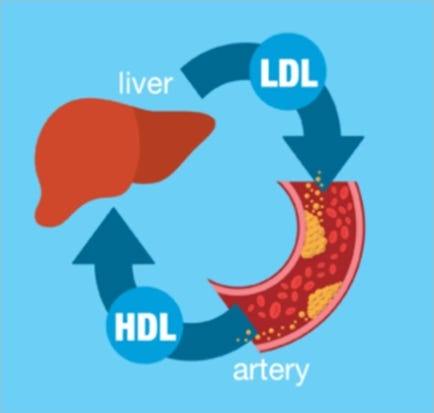
Since cholesterol is a fatty substance, it does not mix well with water, the basic building block of blood. In order to transport it through your arteries, your body produces an interface: water-compatible on the outside and fat-compatible on the inside. This is called lipoprotein. The two best known lipoproteins are low density (LDL) and high density (HDL). The first one is used to carry cholesterol from the liver to cells and hormones. The second one (HDL) goes the other way: it picks up whatever cholesterol is put on the curbside and brings it back to the liver. So far, so good.
The Bad
You’re probably familiar with descriptions like “good cholesterol” (HDL) and “bad” (LDL). The actual picture is more complicated. The common, yet incomplete wisdom is that if there is too much LDL, it may lead to plaque buildup. However, LDL doesn’t just stick to a healthy artery. LDL becomes dangerous when it reacts (“oxidizes”) with other particles, the so-called free radicals. They cause damage to LDL, which then cracks the endothelial lining of arteries, whereby plague forms in the damaged artery. When this calcifies, it may cause atherosclerosis (the stiffening and narrowing of arteries). A well-known result of atherosclerosis is chest pain (angina). Plague also leads to heart attacks and strokes, specifically when the blood clot, that covers the plague build-up, breaks off and creates a blood-flow stopping barrier in the artery. Unthankfully (and inaccurately), this process gave LDL the nickname “bad cholesterol”. The truth is that LDL is good, but oxidised LDL is bad, leading to very bad consequences.
The Ugly
Obviously, when LDL levels rise, the chances of LDL getting damaged go up too. But hold on, I hear you say, wasn’t the liver supposed to tune the amount of LDL? Why would it go off key? The main reason appears to be saturated fats impeding the liver from doing a good job. In other words, when you have your cheeseburger and fries, you’re loading an overdose of saturated fats into your body, blocking the liver to finetune LDL levels.
On top of that, there is another force at play as well: free radicals. Free radicals come from (among others) inhaling bad air, digesting alcohol and ultra-processed foods and insufficient exercise. (Note that the immune system also creates free radicals to fight intruders). When free radicals hit LDL, it causes the LDL to oxidise. Oxidized LDL is the ONLY form of LDL that your immune system will attack. When LDL is damaged, the immune system sends out macrophages. The name macrophages is apt: it is derived from the Greek words for “big eater” and boy do they love OxLDL. They feast on it and leave behind giant foam cells. It is these foam cells which are the primary building blocks of arterial plaque. It is estimated that over 90% of atherosclerosis and strokes are caused by foam cells. Your immune system has been tricked into doing something ugly.
A Happy End
The Good, The Bad and The Ugly can have a happy ending. The four strategies to prevent LDL into turning bad and ugly are:
Antioxidants (scavenge free radicals)
Clean liver (regulate LDL)
Protect LDL from oxidation
Fight low-grade, chronic inflammation
Antioxidants
To prevent CVD, we want to stop the immune system from sending out macrophages which leave these foam cells behind. Therefore, we must prevent LDL from oxidation. The most direct approach is to reduce the number of free radicals. A healthy lifestyle leads to fewer free radicals. On top of that, antioxidants (i.e. vitamins and polyphenols) disarm free radicals. This is why a diet with plenty of fruit and veggies is essential.
Clean Liver
A clean liver will accurately finetune the number of LDL particles. This is where extra virgin olive oil comes into play. Olive oil consists mainly of unsaturated fats. Where saturated fats (found in meat, dairy, and coconut oil) cause the liver to mistune LDL, the unsaturated fatty acids appear to clean the liver and let it do a perfect job.
Protect LDL
The third strategy is to protect LDL from oxidation. Again, olive oil offers the solution. The healthiest oils are not merely rich in unsaturated fats. If that would be the only requirement, all types of olive oil would qualify. Heart-healthy olive oils are rich in oleuropein and oleocanthal. These are two polyphenols only found in olive oil. Oleuropein reacts as a bitter on your tongue. Once inside your body, it is used as a protective shield, preventing the LDL particle from oxidation.
Oleocanthal and Inflammation
The other polyphenol in heart-healthy olive oil is oleocanthal. It fights the harmful consequences of inflammation, the fourth and most important strategy when it comes to health. After all, persistent, low-grade inflammation is the mother of all diseases. The topic of chronic inflammation deserves its own post, so we will address that at a later stage: The Good, The Bad and The Ugly: The Sequel.